OUR STORY
Artistry Began at Home
Long before it had a name.
WHERE IT BEGAN
Weddings, Memory & the Ritual of Making
Artistry began at home, long before it had a name. It began with my mother’s quiet, unwavering love for art, fabric and the process of making something beautiful. In our family, weddings were never simply celebrations. They were cultural events, family projects and, in their own way, acts of remembrance.
These were the weddings where nani’s ghararas and shararas were brought out like heirlooms, folded in muslin and scented with time and memory. Each piece seemed to carry more than embroidery. It carried the hands that had made it, the woman who had first worn it, the occasions it had witnessed and the stories that had travelled with it through generations. Even as a child, I understood that these garments were precious, although it took me many years to understand exactly why.
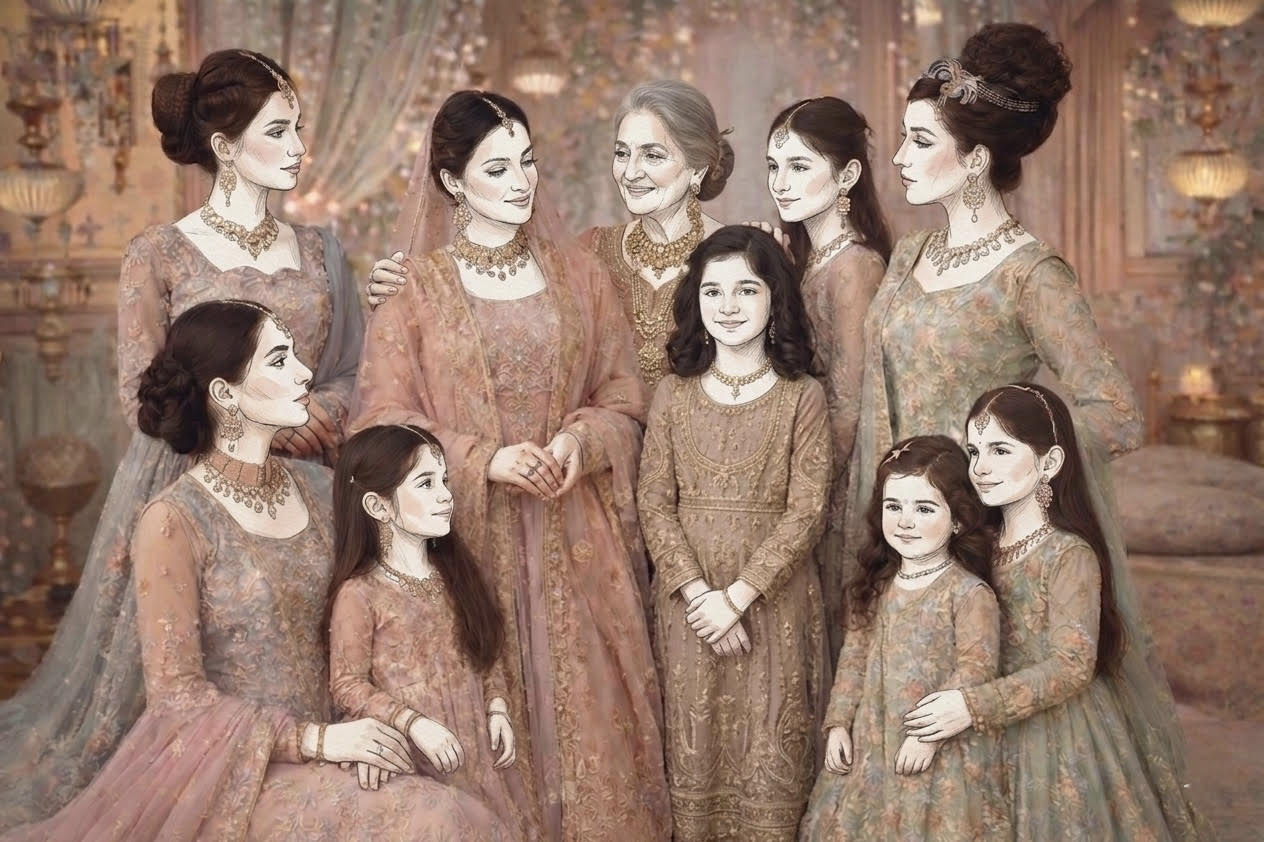
Ours is a large family, full of aunts, cousins, fittings, laughter, opinions and endless excitement. Before every wedding came the same animated questions: who will wear what, and when? Which colour belongs to the mehndi? What should be saved for the wedding? Which old piece can be brought out again? What needs to be made? Dressing beautifully was never treated as vanity. It was part of honouring the occasion, the family and the memories being created around it.
The preparation was often as memorable as the celebration itself. Fabric markets became playgrounds of imagination. Visits to fabric shops, embroidery addas and artisan lanes were not errands to be completed quickly. They were experiences. Colours were debated, borders opened out across counters, embroideries examined closely and fabrics held in the hand to understand their weight, softness, fall and sheen. I grew up watching my mother notice things that I did not yet have the vocabulary for: whether a silk had the right body, whether a georgette would fall correctly, whether a velvet felt truly luxurious, whether the embroidery belonged to the fabric rather than merely sitting on top of it.
AN EYE FOR WHAT IS MADE WELL
Fabric Before Ornament
That sensitivity to fabric remains one of the deepest foundations of Artistry. To us, luxury cannot begin and end with embroidery. A garment may carry hours of beautiful handwork and still fail if the cloth beneath it does not have quality, character and the right relationship with the silhouette. Pure silks, satins, kimkhabs, zarbafs, silk tissues, fine georgettes, chiffons and velvets each have their own purpose. The fabric must be appropriate to what is being made, because drape, movement, texture and finish are as important as ornament. This is something I absorbed almost unconsciously from my mother long before Artistry existed.
As I grew older, my own interest moved deeper into history, art and traditional art forms. The more I looked, the more I understood the knowledge of material, proportion, tension, rhythm, technique and time, carried in the hands of people who had often learnt it within families and communities for generations. My mother had already known and worked with karigars for years. They were never an abstract idea of “craft” to us. They were people she spoke to, returned to, trusted and relied upon when something had to be made properly.
WHEN CRAFT BECAME PURPOSE
Then Covid Changed the Meaning of Those Relationships
As weddings stopped, markets closed and orders disappeared, work for many of the karigars my mother had known for years began to dry up. Her response was instinctive: she kept giving them work. She continued commissioning embroideries, fabrics and pieces even when she had no immediate need for them, and they accumulated at home far beyond what we could possibly use. For her, that was secondary. What mattered was that skilled hands remained occupied and families continued to earn through an extraordinarily uncertain time.
In the last few years, those same artisans began urging her more seriously to take her eye for colour, fabric, proportion and workmanship beyond family weddings and personal commissions. They trusted her judgement because she understood not only what looked beautiful, but what was made well. They believed that something built around that knowledge could also create more regular and sustained work for them.
At the time, she had a comfortable corporate career and very little reason, on paper, to exchange that security for the uncertainty of starting something new. Leaving a familiar world to pursue something she genuinely loved was not an obvious decision. She was understandably sceptical: who would buy from us, and where would the market come from?
I saw that part differently. I convinced her that Instagram and the web had changed what was possible for a small independent label. We no longer needed to rely only on an immediate circle or a traditional retail network to find buyers. What my mother already had was far more difficult to create: relationships built over years, an instinctive understanding of fabric and workmanship, and the confidence of artisans who wanted to continue working with her.
What finally brought the idea together was the encouragement of those artisans, my mother’s trust in me, and my belief that I could build the bridge between their world of craftsmanship and a wider audience. That is when we decided to take the idea forward, and Artistry by Maryam was born.
That founding intention—to create more regular, dignified work for skilled karigars while bringing their craftsmanship to a wider audience—continues to shape how we want Artistry to grow. Wherever the nature of the work allows, we try to ensure that our karigars can continue working from their own towns and villages rather than having to leave home simply to find better-paying work in metropolitan centres. A karigar’s skill does not become more valuable because it has travelled to Delhi or another large city. We therefore try to pay our artisans in their hometowns the same rates we would pay for comparable craftsmanship in a metropolitan centre.
For us, preserving a craft also means making it possible for the people who practise it to remain connected to the families, communities and places in which that knowledge has lived for generations.
WHAT WE WANT TO CARRY FORWARD
Craft With Its Context Intact
For that reason, Artistry was never conceived simply as another label built around the appearance of Indian embroidery. It grew from relationships, from family memory and from a desire to make beautifully while understanding who and what make that beauty possible. We are still at the beginning of that journey, and we do not pretend otherwise. But we can make deliberate choices about how we work, what we value and what kind of story we want each creation to carry.
Indian embroidery, textiles and techniques are increasingly visible across the international language of luxury. That recognition is important and deserved. Yet too often the finished surface travels farther than the story of the hands behind it. At Artistry, we want the craft to retain its context. As we grow, we want the people, processes and traditions behind our work to become increasingly visible through their own names, portraits, voices and making, because craftsmanship should not become anonymous simply because the finished garment is luxurious.
This also shapes the way we think about design. We are not interested in adding handwork merely to make something look expensive. We want fabric, silhouette and embroidery to belong to one another. A fine textile should be allowed to breathe. Heavy zardozi should have structure beneath it. A delicate chiffon or georgette should retain its movement. A kimkhab or zarbaf should be respected for what is already woven into it. The aim is not embellishment for its own sake, but balance, integrity and the feeling that nothing has been added without purpose.
WHERE IT ALWAYS RETURNS
Inheritance, Reimagined in the Present
And despite all these larger ideas, the beginning remains deeply personal. I still think of nani’s garments coming out of their careful folds. I think of aunts and cousins gathered around fabrics, fittings running late, last-minute changes, opinions offered from every corner of the room and the particular excitement of seeing an outfit finally come together. I think of my mother touching a fabric before deciding whether it was worthy of the garment she had in mind. I think of karigars bent over an adda, transforming a drawing into something dimensional through patience and repetition.
Every creation we make sits somewhere between inheritance and the present: between the woman who once preserved a gharara in muslin and the woman who will create her own memories in what she wears today; between the artisan knowledge passed from hand to hand and the contemporary silhouette that gives it a new life; between my mother’s instinctive understanding of fabric and making, and my own desire to document, preserve and carry these traditions forward with thought and respect.
This is not fast fashion. It is memory, material, craftsmanship and labour brought together with intention. When you choose Artistry, you become part of a story that began around family weddings long before there was a brand, and that we hope will continue through the garments, artisans and women who carry it forward.